Parade Song of the Camp Animals
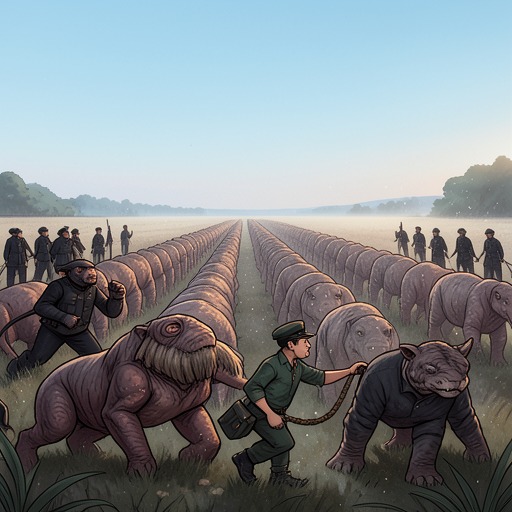
The Jungle BookParade Song of the Camp Animals is the collective song of the animals serving in a military camp, and its decisive significance lies in the change of viewpoint it creates. The parade is not presented only as a human display of imperial order: elephants, gun bullocks, horses, mules, camels, and the camp animals as a whole receive distinct voices, occupations, memories, and forms of pride. Their song converts a massed military machine into a society of specialized bodies whose work makes the parade and the army possible.
Form and Collective Voice
The song is organized as a sequence of occupational sections rather than as one undifferentiated chorus. It opens with the elephants of the gun teams, moves to the gun bullocks, the war-horses, the screw-gun mules, and the commissariat camels, then closes with all the beasts together. This structure gives each class a particular technical identity while reserving the final passage for common membership in the camp. The animals do not erase their differences; they make cooperation intelligible by naming the distinct service each performs.
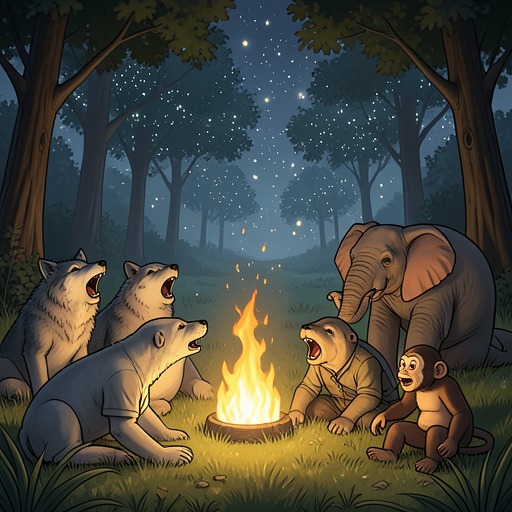
The collective ending gathers these separate voices into the declaration that they are the Children of the Camp, each serving in his degree. The phrase establishes a hierarchy of duties without reducing every animal to the same function. A team hauling artillery, a bullock enduring harness, a horse carrying a rider, a mule climbing a mountain path, and a camel transporting supplies belong to one organization because their unequal abilities are coordinated. The song therefore works simultaneously as a catalogue of species and as a statement of institutional solidarity.
Military Labor and Specialized Skill
The elephants of the gun teams are associated with exceptional strength, judgment, and physical control. Their section claims that they lent Alexander the strength of Hercules, the wisdom of their foreheads, and the cunning of their knees. The boast is comic in scale, but it also assigns intelligence to the elephant body: the forehead and knees become instruments of military competence, not merely signs of brute force. Their passage commands the way for the ten-foot teams of the Forty-Pounder train, presenting artillery movement as a feat that depends on massive, disciplined coordination.
The gun bullocks occupy a more anxious position. Their section calls them heroes in harnesses that avoid a cannon-ball, yet also acknowledges that knowledge of powder upsets them. Courage here is not the absence of fear. The bullocks are valuable precisely because they continue within a dangerous system despite a bodily response to explosions and gunfire. Their humor preserves the animals' vulnerability while recognizing the practical necessity of their labor.
The war-horse section centers on movement, formation, and the rider's control. It evokes the way a cavalry line can be launched in column of squadron and celebrates the distinctive method of the war-horse to Bonnie Dundee. The horse is not simply a vehicle for human command: the song gives it a tradition, a gait, and a professional identity. Elsewhere the troop-horse explains that active service is different from camp play because Dick Cunliffe rides on his back, drives his knees into him, and requires him to watch his footing, keep his hind legs well under him, and be bridle-wise. The song's military pride therefore rests on disciplined bodily skill rather than on abstract obedience alone.
The screw-gun mules represent endurance in difficult terrain. Their section begins with companions scrambling up a hill while the path disappears among rolling stones, yet they continue forward. Their celebrated delight on a mountain height, with a leg or two to spare, turns hardship into a mark of competence. Unlike the elephant's monumental strength or the horse's controlled speed, the mule's distinction is persistence where the route itself seems to vanish. The song makes rough ground part of the mule's professional world.
The commissariat camels are given no grand heroic tune of their own, and that absence is itself characteristic. Their work belongs to the supply system that sustains the more visible arms of the army. By including them after the combat and transport animals, the song recognizes that military power depends on provisioning as well as fighting. The camel's distinct voice keeps logistical labor within the field of honor even when it lacks the spectacle of artillery or cavalry.
The Camp as a Military Society
The song's background is the enormous camp at Rawal Pindi, where thirty thousand men and thousands of camels, elephants, horses, bullocks, and mules gathered for review by the Viceroy of India. The camp also contained the Amir of Afghanistan and a bodyguard of eight hundred men and horses unfamiliar with such a camp or with locomotives. At night, the unfamiliar horses could break their heel ropes and stampede through the mud, while camels might break loose and overturn tent ropes. The parade's apparent order thus exists beside fear, confusion, weather, and the constant possibility of bodily disruption.
That contrast gives the song much of its force. The review displays a controlled line, but the surrounding narrative shows how easily animals and equipment can become unmanageable: a camel blunders into a tent, the tent collapses as its pole snaps, and the camp becomes a scene of roaring, grunting, bubbling, and movement through slush. The song answers this disorder not by pretending that fear does not exist, but by converting the animals' separate anxieties into a shared account of service. Its rhythm imagines order as something repeatedly achieved through training and cooperation.
The animal voices also expose the command structure that human ceremony tends to conceal. Men inspect, harness, ride, feed, chain, and deploy the animals, while the animals supply the strength and technical knowledge that make those commands effective. The song's repeated occupational divisions resemble a military chain of function: elephants move the heavy guns, bullocks endure artillery work, horses carry cavalrymen, mules negotiate mountain routes, and camels maintain transport. The final chorus makes this dependence audible by naming the animals as members of the camp rather than as silent equipment.
Contrast with Other Animal Songs
Within the wider book, animal song serves several different purposes. The hunting lesson taught by Baloo gives speech a legal and protective function: the Strangers' Hunting Call asks permission to hunt outside one's own grounds, and the answer limits hunting to food rather than pleasure. Matkah's low seal song is a maternal lullaby, while Shiv and the Grasshopper preserves a mythic explanation of animal life through a mother's song to her baby. Rikki-tikki-tavi's story includes Darzee's songs, whose celebration and mistaken death song show that song can misread an immediate crisis as well as interpret it.
Parade Song of the Camp Animals belongs to a different register. It is neither a private lullaby nor a rule spoken between members of a wild community. It is a public, occupational chorus shaped by a military environment. The animals' voices are organized into units, and their claims are connected to the work that humans demand of them. Yet the song still resembles the jungle and sea narratives in one crucial respect: it makes animals bearers of memory, judgment, fear, pride, and social knowledge. The camp becomes legible only when its nonhuman workers are allowed to speak.
The surrounding animal narratives sharpen the song's ethical tension. Kotick witnesses men selecting seals, separating those bitten or overheated, and clubbing the others before stripping their skins; the other seals dismiss his horror because they did not see the killing, and his status as a white seal sets him apart. Rikki-tikki-tavi's war in the bathrooms of the bungalow is likewise described through animal action and advice, though the mongoose performs the real fighting. Against these scenes of slaughter and conflict, the parade song presents animals as organized contributors to a human institution. It does not remove their subordination, but it refuses to leave their work voiceless.
Narrative and Thematic Significance
The song creates a miniature political and ecological map of the camp. Different species are sorted according to bodily capacities, environments, and tasks, then joined by a common institutional identity. The elephant belongs to the gun team, the mule to the mountain, the camel to supply, and the horse to the rider and formation. Their social place is produced through use, but the song's first-person plural energy gives that use an answering consciousness.
Its humor is equally important. The animals exaggerate their powers, mock their own fears, and turn specialized labor into performance. The bullocks' unease around powder, the mules' pride in surviving broken paths, and the camels' lack of a camelty tune prevent the parade from becoming solemn propaganda. The animals know that the human army depends on them, and the song lets that knowledge appear as boasting, complaint, and fellowship.
The final movement does not resolve the contradiction between service and control. The animals are celebrated as indispensable members of the camp, yet their bodies remain harnessed, ridden, loaded, or directed. This double meaning is the song's central achievement. It honors cooperation while exposing the material foundation of military spectacle: a vast arrangement of animal strength, fear, training, and endurance. Parade Song of the Camp Animals thus turns ceremony into testimony, allowing the parade to be heard from below as well as seen from above.